
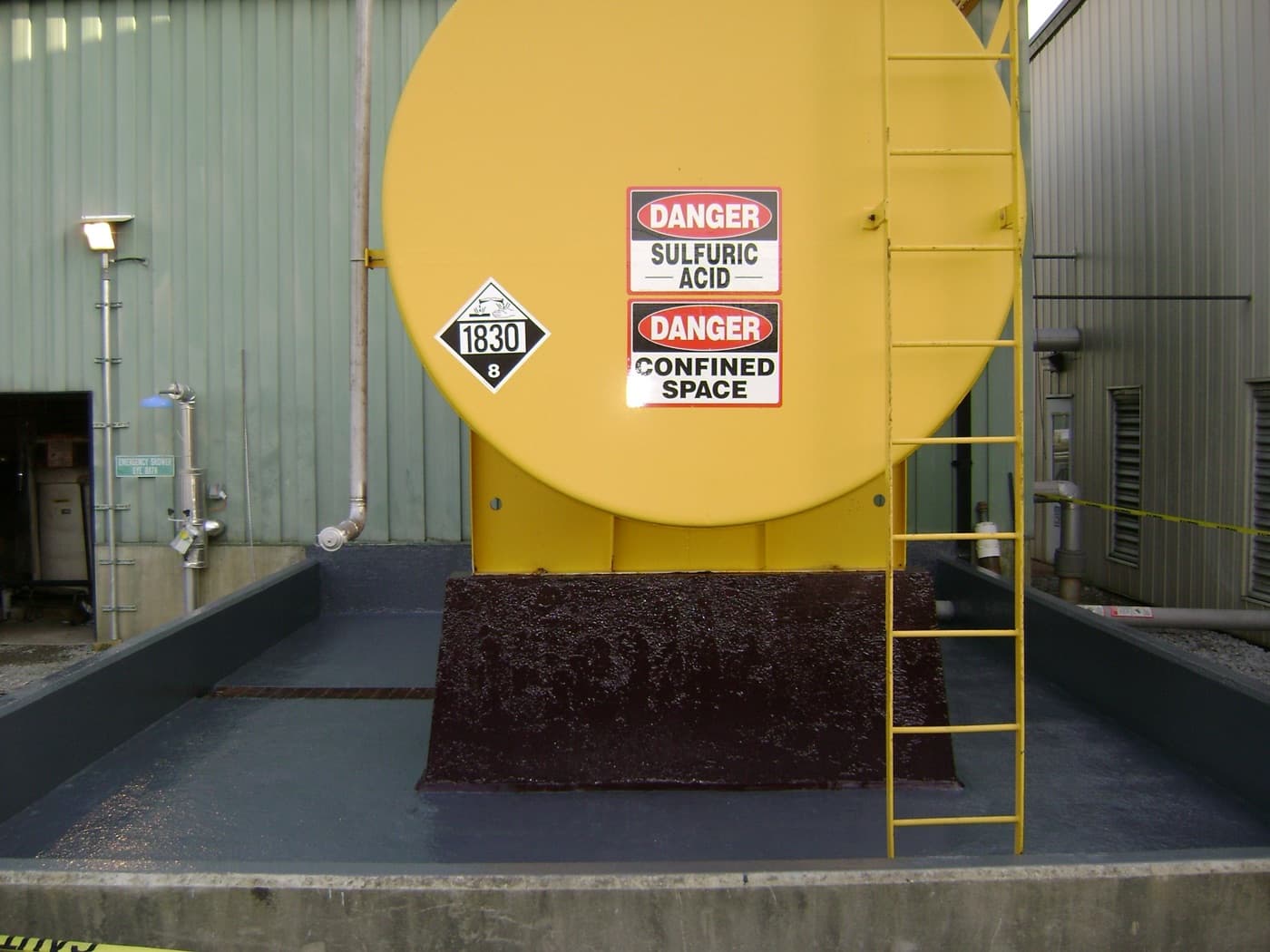
Secondary and chemical containment lining
Porous concrete and cracked joints let spilled acid, alkali, or process product travel through the bund and reach surrounding soil.
The need for secondary and chemical containment lining
BHI Coatings performs secondary and chemical containment lining across Alvin and the Texas Gulf Coast. Porous concrete and cracked joints give spilled acid, alkali, or process product a route through the bund and into the soil underneath. A containment area that leaks defeats its only purpose and puts the facility out of step with its SPCC plan. A failed bund is what turns a contained spill into a reportable release.
How BHI Coatings does secondary and chemical containment lining
We prepare the concrete, fill cracks and joints, and line the containment zone with a chemical-resistant system matched to the worst-case spill, drawing on the Belzona 4311, 4341, and 4361 coatings. The lining bridges the joints and seals the porous surface, so the bund holds liquid instead of wicking it away. It is all cold-applied, with no hot work.
Typically applied with Belzona 4311, Belzona 4341, Belzona 4361, matched to the service conditions.
The containment area holds the volume the SPCC plan requires and keeps a spill where it lands instead of in the soil.
More Tank & Containment Lining applications
Bund walls spall from the inside out, exposing rebar and opening cold-joint cracks until the wall no longer holds its rated volume.
Learn more →Chemical storage tank liningsStored chemicals attack tank floors and the floor-to-shell weld, thinning steel where stagnant product settles and the old lining has worn through.
Learn more →Digester lining and repairKraft digesters carry hot sulfate-rich liquor that thins linings and corrodes every weld and access port over a single campaign.
Learn more →Evaporator, de-aerator and autoclave liningEvaporators, de-aerators, and autoclaves run hot and wet, so conventional linings break down and the shell corrodes at welds and tube zones.
Learn more →Food and beverage hygienic liningsTanks and troughs in food and beverage plants face daily caustic wash-down and hot CIP cycles that ordinary coatings cannot pass on audit.
Learn more →Potable-water tank liningInternal corrosion in drinking-water tanks and pump components forces a choice between costly replacement and a certified recoat.
Learn more →All 12 in Tank & Containment LiningThe whole capability in one place, with the work grouped.
See the capability →Contact BHI Coatings
Have equipment that needs to stay in service?
Tell us what is failing. We respond quickly, and we offer 24-hour on-call service.